

Picture this: you’ve stayed late all week to help your team hit a tight deadline. You’re proud of the effort, but when payday arrives, your check doesn’t reflect that extra time. It feels unfair and frustrating – you want to do right by your job, but wonder if those unpaid hours were even legal, or if your employer may have broken wage and hour rules.
At The Crone Law Firm, we see this often. Both employees and employers misunderstand what the law actually says about overtime authorization and pay. The truth is that wage and hour compliance in TN isn’t just about paperwork – it’s about protecting people’s time, pay, and trust. If you suspect your overtime wasn’t handled correctly, or if you manage a business and want to stay compliant, this article can help you understand your rights and obligations.
Understanding Wage and Hour Compliance in Tennessee
Complying with wage and hour requests means following federal and state rules that govern how employees are paid for their time. In Tennessee, those standards come from the Fair Labor Standards Act (FLSA) and from additional state labor regulations.
To stay compliant, employers must follow a few core principles that form the foundation of fair pay and proper overtime management:
Keep Accurate Time Records
Accurate time tracking is the foundation of wage and hour compliance. Every worked hour must be documented, whether it’s logged through a digital timekeeping system, punch card, or manual entry.
Employers are the ones legally responsible for maintaining these records and ensuring they reflect real hours worked, including short breaks, remote work, or after-hours tasks. Inaccurate or missing records often become the key evidence in wage disputes, so consistency and transparency are critical.
Clearly Classify Employees as “Exempt” or “Non-Exempt”
Not every employee is automatically entitled to overtime pay. The law separates workers into two main categories: exempt (not eligible for overtime) and non-exempt (eligible). This classification depends on factors such as job duties, level of responsibility, and salary threshold – not just whether someone is paid hourly or salaried.
Employers who misclassify staff, intentionally or accidentally, can face severe penalties and back-pay obligations. Regular audits with HR or legal counsel help ensure each position is correctly categorized under Tennessee and federal wage laws.
Pay Overtime Correctly and On Time
Even when overtime is properly tracked and approved, payment errors can still happen. The law requires employers to pay time and a half for all hours worked beyond 40 in a single workweek.
That means if an employee earns $20 per hour, each additional hour over 40 must be paid at $30. Employers must also ensure that these payments appear in the same period the work occurred, not delayed or “rolled over” into future checks.
Timely and accurate overtime pay demonstrates compliance and protects employers from back-pay claims, while giving employees confidence that their time is valued and fairly compensated.
Failing any of these duties can lead to back-pay penalties or even lawsuits.
“Wage and hour law isn’t meant to trap anyone, it’s there to keep everyone honest. When both sides understand the rules, most conflicts disappear before they start.” – Alan Crone, Founder of The Crone Law Firm.
So what do those rules actually say about overtime approval?
Do Employers Have to Approve Overtime?
Yes – and no.
Employers in Tennessee can require employees to get approval before working overtime, but that doesn’t change the employer’s duty to pay for time actually worked.
If an employee works 45 hours without authorization, the company must still pay for those 5 extra hours at time-and-a-half.
However, the employer can discipline the worker for breaking policy.
Employer overtime approval policies should be written, consistent, and enforced fairly. Ideally they include:
Prior Written or Digital Approval for Extra Hours
A strong policy starts with clarity. Employers should require all overtime to be approved in writing – whether through an email, scheduling app, or HR platform. This written record protects both sides: employees can prove they followed procedure, and employers have documentation showing when and why extra hours were authorized.
In Tennessee, clear approval procedures also reduce disputes over unauthorized overtime, where workers stay late without notice. By setting expectations upfront and maintaining digital records, businesses create transparency and consistency across departments.
A Clear Chain of Command for Authorization
Confusion often arises when it’s unclear who can approve overtime. A well-designed compliance system defines exactly which supervisors or managers have the authority to grant additional hours. This not only prevents mixed messages but also ensures accountability when payroll reviews overtime entries.
When multiple people manage schedules or shifts, having a single point of approval streamlines communication and prevents accidental violations of overtime approval rules. Employees should know who to ask and managers should know when to escalate requests.
Transparent Time-Tracking Systems
Even the best overtime policies fail without reliable timekeeping. Transparent time-tracking tools (such as digital punch systems, secure log-ins, or mobile apps) ensure that all hours worked are visible and accurate.
This visibility is crucial. Employers can monitor work patterns, identify repeated overtime requests, and flag potential errors before they become violations. Employees, in turn, gain peace of mind knowing their hours are properly logged and approved.
The key is openness: both sides should be able to verify records easily, without hidden edits or unclear adjustments.
But even the best policies get tested when overtime happens unexpectedly. That’s where confusion (and legal risk) often begins.
What Counts as Unauthorized Overtime in TN
“Unauthorized overtime” doesn’t mean “unpaid overtime” – it simply refers to hours worked without prior approval. When employees stay late to finish tasks, help a customer, or clean up, these intentions that can still trigger compliance problems if pay isn’t adjusted.
Authorized vs. Unauthorized Overtime in Tennessee
Here’s how Tennessee law treats different overtime situations and when employers must still provide pay:
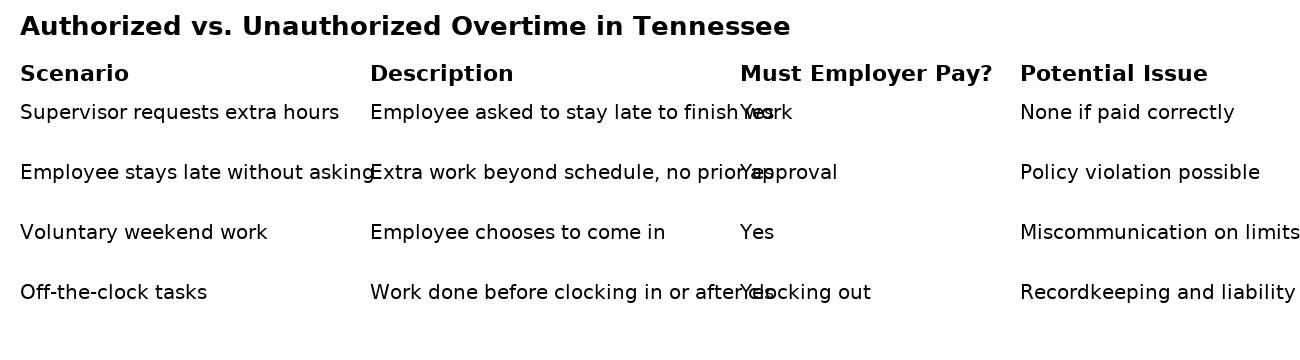
As the table shows, employers must pay for all time worked, even if the overtime wasn’t pre-approved. They can still discipline employees who break rules, but they can’t refuse pay.
And the truth is that unpaid “unauthorized” overtime adds up quickly. For employers, small mistakes can multiply into hundreds of hours and attract Department of Labor attention.
To prevent that, it’s vital to understand where most approval systems fail.
Common Employer Mistakes with Overtime Approval Rules
Even careful employers can slip. Let’s look at the most frequent causes of wage and hour compliance problems in TN.
1 · Assuming Salaried Means Exempt
One of the most common wage and hour compliance mistakes in Tennessee is assuming that a salaried employee is automatically exempt from overtime. In reality, exemption depends on job duties and responsibilities, not just pay structure.
For example, to qualify as exempt under federal law, an employee typically must manage others, exercise independent judgment, or perform professional work that requires advanced education. Many salaried administrative or support roles don’t meet that standard.
When businesses misclassify workers, even unintentionally, they risk years of back pay and penalties for unpaid overtime. Regular classification audits can help employers avoid these costly errors.
2 · Ignoring Off-the-Clock Work
Tasks done outside normal hours, like answering texts from a supervisor, finishing reports at home, or setting up early for a shift still count as work time. Under wage and hour compliance rules, if the activity benefits the employer, it must be paid.
Even a few unrecorded minutes each day can add up to significant unpaid time over the course of a year. Employers should encourage workers to record all time worked, no matter how small, and ensure their policies explicitly forbid “off-the-clock” labor. Transparency here protects everyone.
3 · Averaging Hours Over Two Weeks
It might seem fair to balance a slow week against a busy one, but under the FLSA, that’s not allowed. Each workweek stands alone.
If an employee works 30 hours one week and 50 the next, the second week still requires 10 hours of overtime pay, regardless of the average. Many payroll systems make this mistake, unintentionally violating overtime approval rules.
The fix is simple: define a consistent workweek for your organization and calculate overtime based only on that seven-day window.
4 · Relying Only on Verbal Approvals
When overtime authorization happens through quick hallway conversations or text messages, it’s nearly impossible to prove later. Without written or digital confirmation, disputes often come down to conflicting memories.
Employers can avoid this by requiring prior written or digital approval and storing all approvals in one system. This protects both management and employees by creating a verifiable trail for every overtime decision. Documentation is key to wage and hour compliance and helps prevent confusion about what was or wasn’t authorized.
5 · Retaliating Against Overtime Complaints
Sometimes, the problem isn’t unpaid overtime itself – it’s what happens after an employee speaks up. Any negative action tied to reporting a wage issue, such as reducing hours, demotion, or termination, can be considered retaliation.
Retaliation claims are serious under both Tennessee and federal law, and they often result in higher damages than the original unpaid overtime case. Employers should train supervisors to handle complaints respectfully and route them through HR or legal counsel. Employees, meanwhile, should know that they’re protected by law when asserting their right to fair pay.
Each of these mistakes can be corrected with clear policies and legal guidance. That’s where the experience of employment attorneys becomes invaluable.

How The Crone Law Firm Helps Protect Your Rights
Whether you’re fighting for unpaid overtime or working to keep your business compliant, we can help both sides:
For Employees
- Review pay and time records
- Identify unauthorized overtime TN situations
- File wage claims or lawsuits when necessary
- Negotiate fair settlements for unpaid wages
For Employers
- Audit overtime approval policies
- Train managers on recordkeeping
- Correct classification or tracking errors
- Prevent future disputes through proactive compliance
“Most wage disputes don’t start with bad faith – they start with confusion. Our job is to clear that up before it turns into conflict.” – Alan Crone, Founder of The Crone Law Firm.
If you believe your overtime was unpaid, or your company’s policies might not meet current standards, we can help you navigate through these difficult situations.
Common Questions About Overtime Approval and Compliance
Can an employer refuse to pay for unauthorized overtime in TN?
No. Payment is required for all time worked. Employers may discipline policy violations but cannot withhold pay.
What if my boss didn’t approve my overtime but I worked it anyway?
You’re still entitled to overtime pay. Keep records and consult an attorney if your paycheck doesn’t reflect those hours.
Are all salaried employees exempt from overtime?
Not automatically. Exemption depends on duties, salary threshold, and level of authority.
What if I’m punished for reporting unpaid overtime?
That may be illegal retaliation. You could have an additional claim for damages – seek legal advice promptly.
How long do I have to file a claim in TN?
Generally two years (three if willful). The sooner you act, the stronger your evidence.

Staying Compliant and Protected in Every Workweek
Overtime issues can strain workplaces. but they can also be solved.
When employers maintain clear policies and workers understand their rights, fairness follows.
Wage and hour compliance protects both sides. Whether you’re recovering unpaid wages or reviewing your company’s practices, expert guidance helps you move forward with confidence.
If you are worried about compliance, contact our Memphis office today for a confidential consultation. Your time matters, and so does your pay.
About the Author
Alan Crone is the founder of the Crone Law Firm. With decades of experience in employment law, his mission is to help clients navigate complex legal issues while safeguarding their rights and businesses. Connect with him on LinkedIn to learn more about his expertise and leadership in the field.