

For many doctors and healthcare professionals, the first sign of trouble comes in a thin envelope. The letterhead says “Medical Board,” and in that moment, your stomach drops. A patient complaint, a colleague’s report, or even an unrelated criminal charge has triggered a review. Suddenly, everything you’ve built – your reputation, your career, your livelihood – feels uncertain.
If your medical license is under investigation, you are not alone. Every year, thousands of physicians, nurses, and other licensed providers face inquiries from state boards. Some walk away with a warning, while others face probation, suspension, or even revocation. The difference often comes down to how early and effectively they respond.
This article is here to help you understand what an investigation means, what steps to take immediately, and how an experienced medical board investigation lawyer can give you a real chance at defending your career. While the process is intimidating, it’s not hopeless. With the right strategy, many professionals continue practicing medicine even after a review.
Understanding What a Medical License Investigation Means
When your license is under review, it doesn’t necessarily mean you’ve done something wrong or that your career is over. Investigations are the board’s way of ensuring patient safety and professional accountability. Let’s explore more:
Why Investigations Happen
Some of the most common triggers include:
- Patient complaints about treatment, communication, or outcomes.
- Prescription misuse or questions about opioid prescribing.
- Substance abuse or impairment concerns.
- Professional conduct issues, such as boundary violations.
- Criminal charges, even if unrelated to your practice.
Boards aren’t looking to punish for sport – they are tasked with protecting the public. But once an allegation is made, they must take it seriously, no matter how small it seems.
Common Misconceptions
Many professionals panic and assume an investigation will inevitable lead to a suspension, but that’s not always true. In fact:
- Some cases end with a warning letter and no formal discipline.
- Others result in probation with conditions like counseling or extra supervision.
- Only the most serious cases (patterns of misconduct or sexual harassment) may lead to suspension or revocation.
Understanding the board’s role is the first step. The next is knowing how to respond without making things worse.
First Steps After Your Medical License Is Under Investigation
The first few days after receiving notice are crucial. What you do or don’t do can shape the outcome. Here’s how:
✅ Do’s: Steps That Protect You Right Away
Do read the notice carefully.
Board letters are filled with deadlines, instructions, and sometimes requests for records. Missing a date or misunderstanding a request can harm your case.
Do preserve all records.
Hold onto everything that could matter: patient charts, prescriptions, emails, text messages, even phone logs. These details often make the difference in whether a complaint is substantiated or dismissed.
Do keep your practice running professionally.
Continue providing care as usual. Patients, colleagues, and staff are often quietly observing how you handle stress. Professionalism during this time can help your reputation later.
Do consult a healthcare attorney immediately.
The sooner you get representation, the better your defense. An experienced medical board investigation lawyer can guide your responses, prevent missteps, and begin preparing a defense strategy from day one.
❌ Don’ts: Actions That Could Backfire
Don’t ignore the letter.
Silence isn’t neutral – it’s harmful. Failing to reply within the stated timeframe may be viewed as non-cooperation, which can escalate the board’s response.
Don’t contact the complainant.
Whether it’s a patient, coworker, or supervisor, reaching out directly to “fix things” almost always backfires. It can be seen as intimidation or interference, and investigators may use it against you.
Don’t give off-the-cuff statements.
Well-meaning explanations often read differently in official transcripts. A casual word can be misinterpreted as an admission. Always review responses with your lawyer before saying or writing anything to the board.
Don’t assume it will go away on its own.
Even if the complaint feels frivolous or unfair, boards are legally required to investigate. Treat the process with seriousness from the very beginning.
Remember: taking the right actions (and avoiding the wrong ones) sets the stage for your attorney to build a strong, credible defense.
When to Contact a Lawyer
Many professionals wait, thinking they can “explain it away” in their response. But board investigators are trained to read statements critically, often in ways that don’t favor the doctor. Having a lawyer shape your response from the start prevents unnecessary admissions and ensures your side of the story is properly framed.
For many clients, this means calling an attorney before you even pick up the phone to the board. A medical license defense begins with strategy, not just reaction.
Once you’ve taken these first steps, the focus shifts to how your defense will be built.

How a Medical Board Investigation Lawyer Builds Your Defense
An investigation is not just about facts – it’s about interpretation. The same patient chart that looks neutral to you might look incriminating to a reviewer. That’s why having someone who understands both law and healthcare is critical.
Protecting Your Rights
A lawyer serves as your shield. They:
- Handle all board communications.
- Ensure deadlines are met.
- Push back against unfair or irrelevant allegations.
Instead of you defending yourself under stress, your lawyer presents a calm, strategic narrative.
Gathering Evidence and Testimony
Medical board cases often hinge on detail:
- Did the records clearly show informed consent?
- Were controlled substances logged properly?
- Did colleagues witness impairment – or was it rumor?
An attorney can bring in expert witnesses to review records and testify, often reframing what looks like a violation into an acceptable medical decision.
Mitigating Allegations
Not every case is about “guilt or innocence.” Sometimes, the board simply wants reassurance. A lawyer might recommend:
- Voluntary enrollment in a physician health program.
- Ethics or boundary training courses.
- Monitoring agreements that show accountability.
“Our role is to protect careers while restoring trust. Sometimes that means fighting allegations outright. Other times, it means showing the board our client is committed to growth and patient safety.” – Alan Crone, Founder of The Crone Law Firm.
Our team at The Crone Law Firm is ready to help protect your license and guide you through this process. And with a defense strategy in place, the next step is understanding the board investigation process itself.
What the Board Investigation Process Looks Like
Every state handles investigations differently, but most follow a similar path:
1. Informal Review
This is often the first step. The board may request records, written statements, or an interview. Sometimes, cases are resolved here with no formal action.
2. Formal Hearing
If concerns remain, the board may hold a hearing. This resembles a trial, with evidence, witnesses, and cross-examination. Having legal representation at this stage is critical, because once testimony is on the record, it’s hard to undo.
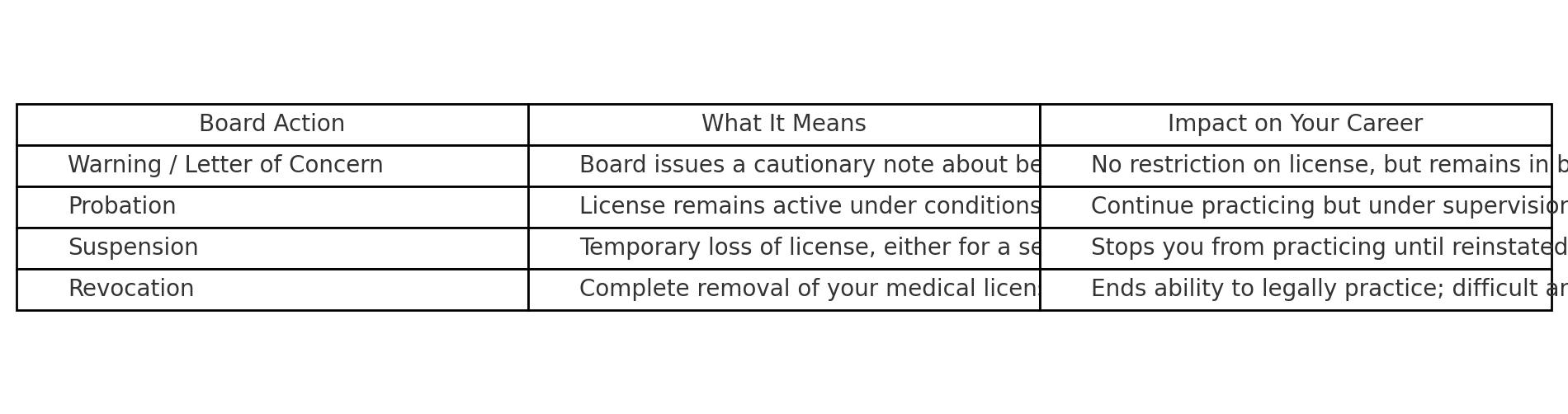
3. Possible Outcomes
- Warning or Letter of Concern: No restriction but a note in your file.
- Probation: Continued practice with monitoring or conditions.
- Suspension: Temporary loss of license, often pending further review.
- Revocation: Complete loss of license, often for serious or repeated violations.
4. Tennessee Nuances
If you practice in Tennessee, you should know:
- The Tennessee Board of Medical Examiners follows strict deadlines, and missing them can mean automatic penalties.
- Self-reporting obligations are stronger than in some states. Failing to report a criminal conviction can itself be grounds for discipline in TN.
- Investigations may involve both state and federal reporting systems, impacting DEA registrations and hospital privileges.
At this stage, the difference between suspension and revocation becomes critical, because one may allow you to return to practice, while the other could end your career.
Protecting Your Career and Moving Forward
Even after an investigation, your career isn’t over. Many physicians continue practicing with renewed caution, stronger documentation, and, in some cases, board-imposed safeguards.
Compliance and Rehabilitation
Showing the board that you’ve addressed concerns can make a big difference. Examples include:
- Completing continuing medical education (CME) in high-risk areas.
- Participating in monitoring programs.
- Implementing stronger internal policies in your practice.
Rebuilding Reputation
Patients and colleagues may hear about the investigation. Transparency and professionalism help rebuild trust. Many doctors choose to address concerns directly, acknowledging the process and emphasizing their commitment to patient safety.
Long-Term Legal Strategy
Sometimes, the battle doesn’t end with the board. Disciplinary records may affect hospital privileges, insurance panel participation, and DEA licensing. A healthcare attorney helps you anticipate these challenges and minimize long-term damage.
If your license is at risk, don’t go through it alone. We are here to give you the defense, strategy, and support you need to protect your livelihood.

Common Questions About Medical License Investigation
How long does a medical license investigation take?
It varies. Some end in weeks; others stretch for months or years depending on complexity.
Can you work during an investigation?
In most cases, yes – unless the board issues an emergency suspension.
Do I need a lawyer if it’s my first board complaint?
We highly recommend it. Even a single complaint can set precedents for future actions. Early representation matters.
What if the complaint is false?
False complaints still require response. Boards must investigate all allegations, and silence can be taken as admission.
Protecting Your Medical License and Your Future
A medical license under investigation is one of the most stressful experiences a healthcare professional can face. It touches not only your career but your identity as a caregiver. While the process is serious, it’s not hopeless. With early action, careful planning, and the right legal defense, many providers come through investigations still practicing and still serving their patients.
Your career deserves protection. Contact our Memphis office today to speak with a healthcare attorney who understands how to fight for your license and your future.
About the Author
Alan Crone is the founder of the Crone Law Firm. With decades of experience in employment law, his mission is to help clients navigate complex legal issues while safeguarding their rights and businesses. Connect with him on LinkedIn to learn more about his expertise and leadership in the field.