

Picture this: you’ve spent years in training, logged thousands of hours in hospitals and clinics, and built a reputation as someone patients trust with their lives. Then one day, a letter arrives from the state medical board. It’s short and formal, but its message cuts deep: your license is under review.
For many doctors and healthcare professionals, this moment feels devastating. Questions start swirling: Will I lose my license? How will this affect my career? Who will care for my patients?
But here’s the truth: while board investigations are serious, they don’t always end in license loss. Many professionals continue practicing after facing disciplinary action – especially when they approach the process with preparation and legal guidance.
That’s why we wrote this article. Our goal is to help you understand the top reasons doctors lose medical license privileges and, more importantly, what steps you can take to protect your career if you’re facing a complaint or investigation.
Most Common Reasons Doctors Lose Medical License
State medical boards exist to protect patients and uphold the integrity of the profession. When complaints come in, boards investigate to determine whether a healthcare provider’s actions or inactions pose risks to public safety.
Let’s look at the most common causes of medical license discipline, and why boards treat them so seriously.
Substance Abuse Issues
This is one of the leading triggers for medical board investigations. While some cases involve serious criminal conduct, others begin with something more subtle, like a physician self-medicating during an especially stressful period.
But once signs of prescription misuse, alcohol dependency, or illegal drug use become visible, boards move quickly. Their responsibility is to protect patients, and even the possibility of impaired judgment raises red flags.
In many cases, the deciding factor isn’t the existence of a struggle with addiction but whether the professional took proactive steps, such as seeking treatment or reporting the issue, before it escalated to the point of board involvement.
Criminal Charges or Convictions
Even charges that seem unrelated to medicine, such as a DUI, can spark a board review. More serious allegations (like fraud, sexual harassment, or theft) nearly always trigger disciplinary action.
This happens because medical boards view criminal behavior as a red flag for ethical and professional conduct. While a single misdemeanor may not end a career, repeated offenses or felony convictions often tip the scales toward suspension or even permanent revocation.
Professional Misconduct
Doctors are held to strict ethical standards. Misconduct claims often involve:
- Boundary violations with patients
- Sexual assault allegations
- Inappropriate prescribing practices
- Billing fraud or insurance abuse
Even if allegations prove exaggerated, the process of defending against them can be long and stressful.
Negligence and Malpractice Findings
A single malpractice lawsuit won’t always cost a doctor their license. But repeated claims of negligence, especially if tied to patient harm, draw the board’s attention.
Medical boards may review malpractice verdicts or settlements and decide whether they reveal a pattern that puts patients at risk.
Administrative Failures
Sometimes, license problems arise not from malpractice but from paperwork. Missing required continuing education, failing to report a criminal charge, or ignoring board correspondence can all result in disciplinary action.
What feels like a technical oversight to a doctor can be interpreted as negligence by the board.
We understand that whether caused by misconduct, mistakes, or administrative lapses, disciplinary action always feels personal. And to prepare for what comes next, it helps to understand how the process unfolds.
What Medical Board Disciplinary Action Looks Like
The process varies by state, but most follow a similar path. Knowing the stages ahead of time can reduce anxiety and help you plan your response.
Initial Complaint and Notice
Most cases begin with a patient, employer, colleague, or law enforcement agency filing a complaint. The board then reviews whether it falls within their jurisdiction.
If they decide it does, you’ll receive a formal notice. This is often the most stressful moment – seeing your reputation questioned in writing.
Investigation Phase
During this stage, the board gathers documents, interviews witnesses, and may ask you for a written response. They could also request patient records or your appearance at an interview.
It’s tempting to answer quickly, but every statement you make can shape the case outcome. This is where many professionals benefit from legal counsel to ensure their responses don’t unintentionally create more risk.
Hearings and Outcomes
If the board believes discipline is warranted, they schedule a hearing. This functions much like a courtroom trial, where evidence is presented, witnesses testify, and decisions are made.
Possible outcomes include:
- Dismissal of the case (best-case scenario)
- Reprimand or fine
- Probation with conditions (monitoring, retraining, restrictions)
- Suspension (temporary loss of license)
- Revocation (permanent loss of license)
Tennessee-Specific Considerations
Every state medical board follows its own procedures, and Tennessee is no exception. The Tennessee Board of Medical Examiners has broad authority not only to review complaints but also to impose discipline that can affect both a provider’s license and reputation.
One important difference is the board’s use of Consent Orders. These agreements allow physicians to accept certain penalties (such as fines, probation, or mandatory continuing education) in exchange for avoiding a full hearing.
Another nuance is the mandatory reporting requirement. In Tennessee, doctors must report certain criminal convictions, malpractice settlements, or disciplinary actions in other states. Failure to do so often becomes a separate violation, even if the underlying issue has already been resolved elsewhere.
The board also takes a firm stance on substance abuse and impairment programs. Tennessee requires physicians to participate in monitoring or rehabilitation plans when impairment is suspected, and compliance with these programs can significantly influence whether a license is suspended or reinstated.
The next question becomes what kind of discipline is on the table. The difference between suspension and revocation becomes critical, because one may allow you to return to practice, while the other could end your career.

Medical License Suspension Causes vs. Discipline Outcomes
Understanding how boards distinguish between suspension and revocation can help set realistic expectations. Lets explore how:
Suspension Causes
Suspensions are usually temporary and imposed when the board believes immediate patient safety is at risk. Common causes include:
- Allegations of practicing under the influence
- Pending criminal charges
- Ongoing malpractice investigations
Suspensions buy the board time while facts are sorted.
Discipline Outcomes
When investigations conclude, outcomes can range from reprimand to revocation. Boards often consider:
- The severity of the misconduct
- Whether the doctor shows remorse or corrective action
- The presence of prior discipline
For example, a doctor with one lapse in recordkeeping might receive probation, while someone convicted of repeated fraud may lose their license permanently.
Common Causes of Medical Board Discipline and Possible Outcomes
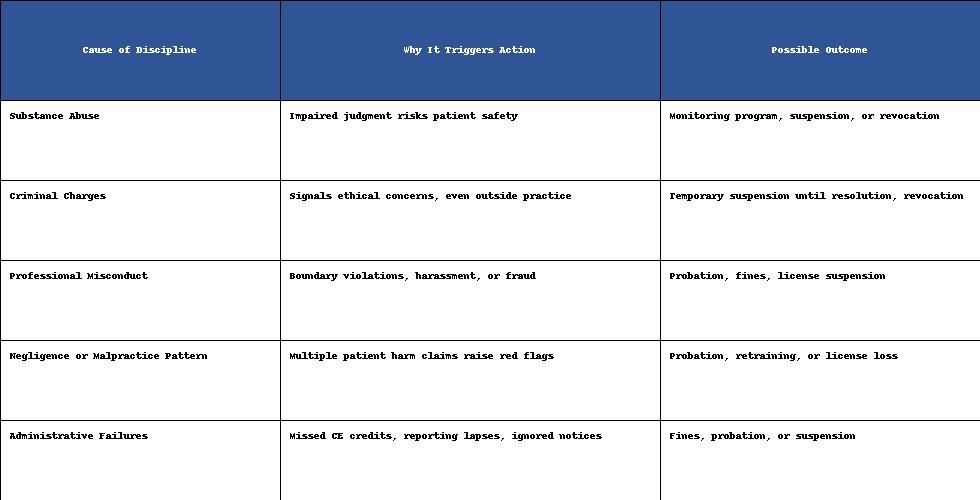
While the consequences vary, one factor consistently influences outcomes: the quality of the defense presented.
How Legal Support Protects Healthcare Professionals
Facing a board investigation without guidance is like entering a courtroom without preparation. The process is legal in nature, and attorneys experienced in healthcare defense can make a measurable difference in how your case is heard.
Building the Defense Case
Attorneys collect and organize evidence, ensuring it tells the full story. This might include patient charts, prescribing logs, or continuing education certificates.
For many professionals, the difference lies in having someone who knows what evidence boards prioritize.
Presenting Professional Context
Discipline decisions aren’t made in a vacuum. A strong defense highlights career history, positive evaluations, and evidence of ongoing learning. Context matters, and a lawyer can ensure it’s part of the record.
Negotiating with Boards
Sometimes, the best outcome is a compromise, such as probation instead of revocation. Attorneys negotiate these terms to minimize the long-term impact on your career.
“When the board calls your integrity into question, you need someone who understands both the law and the medical profession. Our job is to ensure your side of the story is heard.” – Alan Crone, Founder of The Crone Law Firm.
Defense is critical when the board is already investigating – but prevention is equally important.
Proactive Steps to Avoid Medical License Discipline
Many disciplinary actions can be avoided through proactive habits. These steps won’t eliminate risk entirely but can strengthen your standing if issues arise:
Stay Current with Continuing Education
Missed deadlines or incomplete courses send a signal to boards that professionalism is slipping. Mark reminders well ahead of license renewal.
Keep Meticulous Records
From prescriptions to billing, records should be detailed and accurate. Gaps create opportunities for allegations of negligence or fraud.
Address Complaints Promptly
If a patient, employer, or colleague raises a concern, deal with it head-on. Ignoring small issues often makes them worse.
Seek Early Legal Advice
Even if you haven’t received a complaint, consulting with a lawyer after a mistake or concern can prevent escalation.

Common Questions About Losing Medical License
What are the most common reasons doctors lose medical license?
Substance abuse, criminal charges, professional misconduct, malpractice findings, and administrative failures are among the top causes.
Can a doctor work again after medical license suspension?
Yes, suspensions are often temporary. With compliance and legal support, many doctors return to practice.
How long does a medical board investigation take?
It varies by state and complexity, but many last several months to over a year.
Should I contact a lawyer before responding to a board inquiry?
Yes. Even a brief consultation can help you avoid missteps that weaken your defense.
Protecting the Career You Built
A medical board investigation may feel like your future is hanging by a thread. But knowledge, preparation, and the right legal support can shift the outcome.
By understanding the reasons doctors lose medical license privileges and knowing what steps to take, you can move from panic to proactive defense.
You’ve invested too much in your career to face this alone. The Crone Law Firm is here to help you fight for the reputation and practice you’ve worked so hard to build. Contact our Memphis office today to schedule your free consultation.
About the Author
Alan Crone is the founder of the Crone Law Firm. With decades of experience in employment law, his mission is to help clients navigate complex legal issues while safeguarding their rights and businesses. Connect with him on LinkedIn to learn more about his expertise and leadership in the field.